
How Do You Know If Your Subfloor Is Bad?
Your subfloor is probably bad if the floor feels soft or springy in one spot, dips, smells musty, or the floor on top keeps failing: tiles crack, vinyl plank seams open, a toilet rocks. A squeak on its own is usually a loose nail, not rot. To be sure, look at the subfloor itself, from the basement below or with the old floor up.
The Short Answer
A good subfloor is flat, stiff and dry. A bad one gives under your feet, sags between the joists, or has gone soft from water. Most of the time the damage is in one area, near a tub, toilet, sink, dishwasher or outside door, and the rest of the floor is fine. The signs below tell you whether it is worth a closer look.
Signs You Can Check Today
- Soft or spongy spots. Walk the room slowly. A patch that gives under your heel, especially near a tub, toilet, sink or door, is the most common sign of plywood or particleboard that has taken on water.
- Bounce across the whole room. If the whole floor flexes, not just one spot, the cause may be thin subfloor panels or the joists underneath. That needs a look before any new floor goes down.
- Dips and raised seams. Lay a long level across the floor. A low spot that lets the level rock points to a sagging panel. A ridge at a seam can mean a panel swelled with moisture.
- A floor that keeps failing. Cracked tiles or grout in a line, vinyl planks that pull apart, laminate that peaks at the joints and hardwood that cups are often the subfloor showing through.
- A rocking toilet. If the toilet moves when you sit down, the subfloor around the flange may be soft from a slow leak at the wax ring.
- A musty smell or dark stains. From the basement, look up at the underside of the floor. Dark patches, mold, or wood that a screwdriver sinks into are signs of rot.
Squeaks: When They Matter
A squeak by itself usually means a nail has worked loose from a joist as the wood dries and shrinks. Squeaks get more common once the furnace comes on in the fall and the air in the house dries out. A squeak with a soft spot under it is different: it can mean the wood around the fastener has gone soft and no longer holds.
Why Metro Detroit Homes Are Checking Now
Heavy rain moved across Southeast Michigan on October 1, with forecasters calling for one to two inches and minor flooding in low-lying and urban areas. A damp basement or a slow leak after a soaking often does not show on the floor above for weeks. Then the heat comes on, the house dries out, and boards that took on water shrink, squeak or open up. In older homes across Detroit, Dearborn, Livonia and Royal Oak the floor sits over a basement, so the underside of the subfloor is easy to check from below.
Where to Look First
- Bathrooms. Around the toilet and along the edge of the tub or shower.
- Kitchens. In front of the sink and dishwasher, and behind a refrigerator with an ice maker line.
- Laundry rooms. Under and around the washer.
- Entry doors. Inside back doors and sliding doors, where rain and melted snow come in all winter.
- The ceiling below. A stain on the ceiling under a bathroom is often the first sign the subfloor above is wet.
What Happens to a Bad Subfloor
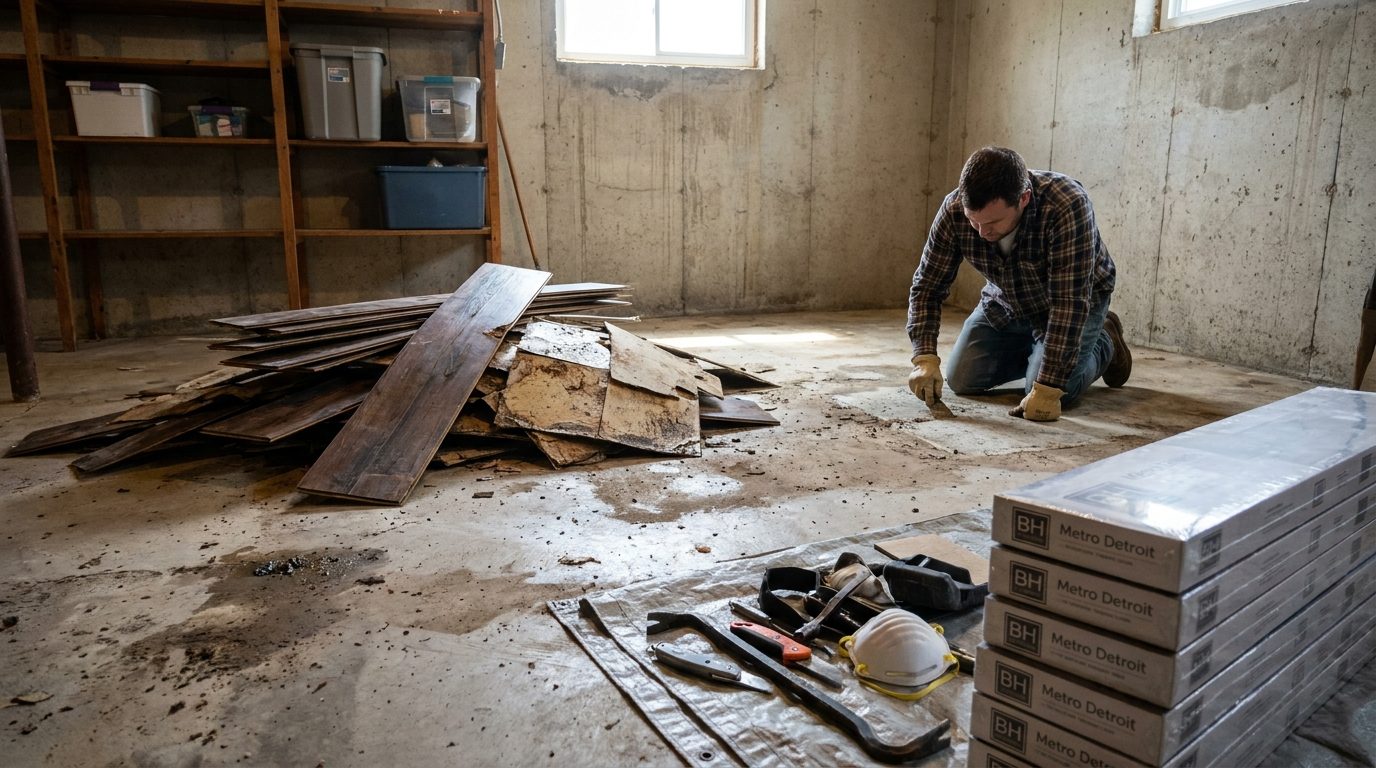
The damage is usually local. In most rooms only the bad section comes out: it is cut back to solid wood over the joists, the source of the water is stopped, the framing dries, and new panels are fastened down. A whole room needs new subfloor only when the damage is widespread or the old subfloor is too thin for the new floor. A new floor should never go down over a soft subfloor. Tile cracks and vinyl plank seams open up.
If the trouble started with a leak or a wet basement, our guide to water-damaged floors in Michigan walks through the dry-out and the rebuild.
What Sets the Price
There is no single number. What drives the cost is how much of the subfloor is damaged, whether the joists under it are sound, what floor has to come up first, and what goes back down.
Talk to a Local Crew
We handle water damage floor restoration and residential flooring across Metro Detroit, and we check the subfloor whenever the old floor comes up. Call (313) 236-4558 for a price on your job, Sunday to Thursday from 9:00 AM to 5:00 PM and Friday from 9:00 AM to 12:00 PM, or send us a message through our contact form.
Think your subfloor is soft?
We work Sunday to Thursday 9:00 AM to 5:00 PM and Friday 9:00 AM to 12:00 PM, closed Saturdays. Call us or send us a message to get started.


